How a glove is made
Every glove starts as flat panels of leather and fabric. This is how they come together, using the reinforced leather work glove (code 13) as the example.
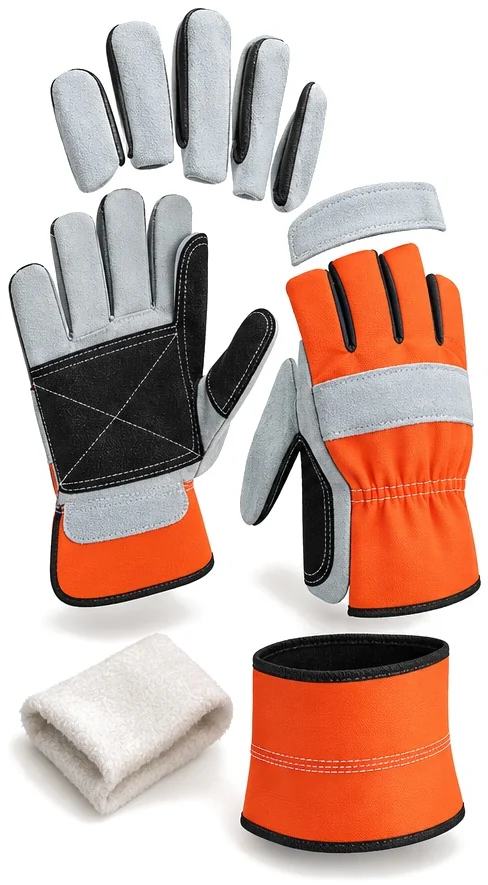
From panels to a finished pair
Cutting
Hide selected; palm & fingers from cow split leather cut to size pattern.
Secondary panels
Back panel from fluorescent orange cotton drill; knuckle overlay from leather strip.
Lining
Fleece lining cut and fixed inside the shell.
Reinforce & detail
Sew on palm overlay and welted fingers.
Stitching
Panels and fourchettes sewn and the glove closed.
Cuff & edge
Attach plain rubberized cuff; bind the edge with black hem.
Finish & inspect
Trim threads, shape, pair, inspect and pack.
What we check on every order
- Leather thickness within tolerance (gauge check on every cut lot)
- No holes, scars or thin spots on palm and fingertips
- Fabric / synthetic shade matches the approved colour standard
- Stitch density as approved; no skipped, open or loose seams
- Lining fully attached; no bunching at fingertips
- Reinforcements and knuckle strip placed and sewn as sample
- Cuff attached square; binding covers the edge fully
- Size label and hand measurements match the size chart
- Left / right pairs matched for colour and size
What we confirm with you first
Leather grade and thickness, fabric weight, lining fibre and coverage, thread, stitch density, colour standard, size chart, labels and packing. Each product page lists exactly which of these apply to that glove.
How ordering works
Choose
Pick gloves, sizes and quantities and send your enquiry list.
Sample
We send a physical sample. You check the leather, lining, stitching and colour.
Agree the spec
We confirm thickness, fabric weight, thread, branding and packing with you in writing.
Produce and inspect
Each order is cut, sewn and checked against the approved sample.
Pack and ship
Packed to your labels and carton plan, with the agreed delivery terms.